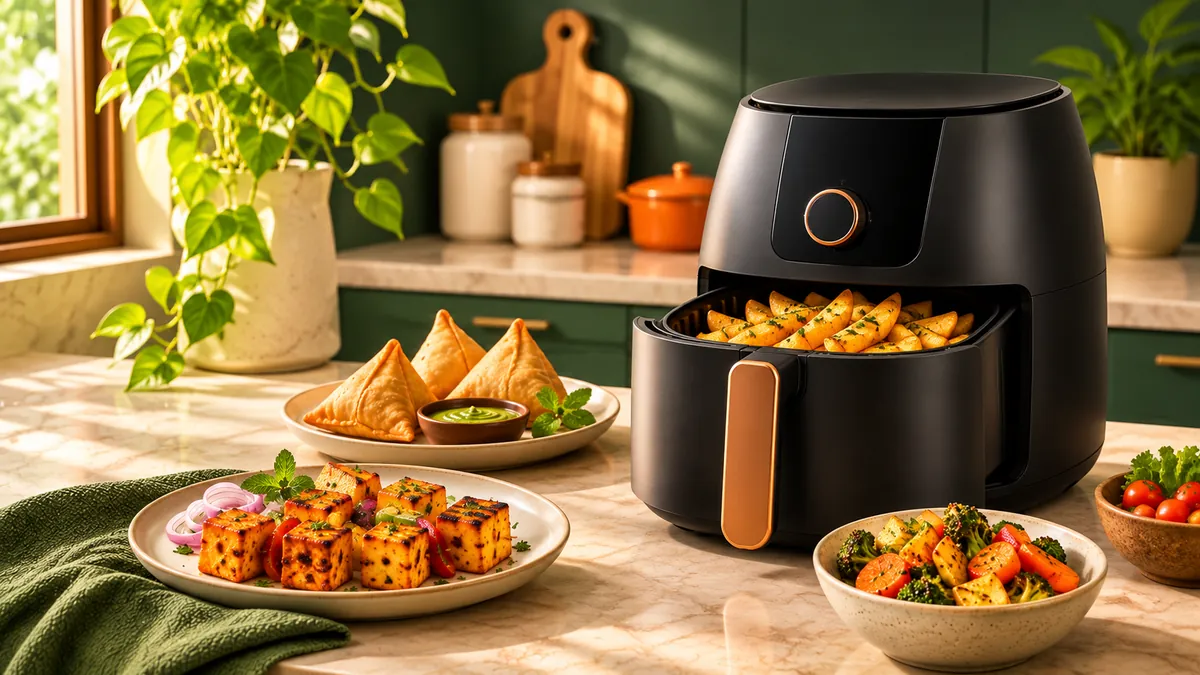
Capacity by household size
| People | Starting range | Practical consideration |
|---|---|---|
| 1–2 | 3–4 L | Small portions and snacks |
| 3–4 | 4–6 L | Side dishes or batches of paneer |
| 5–6 | 6 L or more | Check floor area or dual baskets |
| Large family | Large basket or oven | Compare trays and simultaneous cooking |
Why litres can be misleading
Two 5-litre baskets may have different shapes and usable floor areas. If food must cook in a single layer, basket width can matter more than height. For example, a 20 cm square basket has 400 square centimetres of floor area before accounting for rounded corners, whereas an 18 cm round basket has roughly 254 square centimetres. This is a geometry example, not a measured product specification.
Measure your portions
Lay out your usual paneer cubes, cutlets or chicken pieces on a plate without overlap. Measure the occupied area and compare it to the basket interior, allowing circulation space and following the manufacturer’s fill limit. If you make two courses at once, dual baskets can reduce scheduling conflicts but each basket may be narrower.
Check kitchen space and power
Measure external dimensions, pull-out clearance and ventilation space. Check the rated wattage and electrical requirements. A bigger capacity does not automatically mean better energy efficiency: compare actual cooking time, portion size and batch count.
Start with the food you actually cook
A capacity recommendation should begin with a normal week’s meals. List your three most common air fryer tasks and note how many people eat each dish. A household that uses the appliance only for frozen snacks may need a different basket from one that prepares a full dinner. If you regularly cook flat foods such as cutlets, fish fillets or toast, measure the space they occupy on a plate. For cubed vegetables, thickness and moisture matter as well as area. Avoid treating the stated litres as an exact number of portions, since baskets are different shapes and manufacturers may measure capacity differently.
Worked example: comparing two basket shapes
Suppose two appliances are advertised at the same volume. One has a nearly square floor measuring 20 by 20 centimetres; another has a circular floor with an 18 centimetre diameter. Their theoretical floor areas are 400 and about 254 square centimetres, respectively. Rounded corners, raised edges and the shape of the crisper plate will reduce the usable area. A square basket might be a more convenient fit for rectangular pieces of toast or several cutlets. A round basket may still be sufficient for loose vegetables. These dimensions are hypothetical, so use a product’s actual measurements rather than assuming a shape from its advertised litres.
How many batches will you need?
Place a typical serving on a plate in a loose layer. Repeat for the number of diners you normally serve and estimate how many such portions would fit on the cooking surface while leaving airflow space. If a basket fits only half of the food, plan two batches and consider whether the first batch will stay warm. For a snack, that delay may be acceptable. For a family dinner served together, it may be less convenient. Include preheating and batch time when estimating running cost using the electricity calculator.
Single basket, dual basket or oven format
A single basket is usually straightforward to load and clean. A dual-basket format can be helpful for two different dishes, particularly when the compartments can be set independently, but verify this capability on the exact appliance. Individual compartments may be narrower than a single basket with the same total volume. An oven format can accommodate wider trays if its internal dimensions permit, although loading, turning and cleaning can differ. For larger bakeware or cakes, an OTG may be more suitable. See our air fryer versus OTG comparison.
Check the physical footprint and clearance
Measure the counter where the appliance will sit, including depth for the power cord and room to pull the basket out. Do not forget cupboard height, nearby appliances and the direction of hot exhaust. Leave the clearance required by the model manual instead of assuming a generic distance. Consider where you will place a hot basket when checking food. A large appliance that must be moved every time it is used can be less convenient than a smaller one that has a permanent safe location. Check weight, handle position and the ease of reaching the controls.
Choose accessories after choosing the appliance
A 5-litre accessory kit is not automatically compatible with every 5-litre appliance. Measure the interior and confirm that cookware fits without blocking airflow or approaching the heating element. A baking tin may have a rim wider than its advertised base size. Only use manufacturer-permitted materials and temperature ratings, and never preheat loose parchment that could be lifted by the fan. See the accessory sizing guide. Budget for equipment you will actually use rather than buying a large kit before understanding your basket.
Final shopping checklist
Record the manufacturer, exact model number, basket or tray measurements, maximum fill instructions, external dimensions, wattage and warranty. Check the return terms and whether the seller provides an appropriate invoice. Compare the final delivered price rather than the advertised discount. For examples of different design priorities, explore Philips, Pigeon and AGARO. The right capacity is the one that fits your portions and kitchen without requiring unnecessary expense. Treat the suggested litre ranges as starting points, not precise performance ratings.
FAQs
Is a 4 litre air fryer enough for four?
It can suit snacks or side dishes, but full meals may require multiple batches. Compare usable floor area.
Is a 6 litre appliance too large for two?
Not if you batch cook or use wide cookware; otherwise the extra counter space may be unnecessary.
Read our family of four guide, budget guide and Indian cooking guide.
See our research methodology and affiliate disclosure.
Try the free tool: Use our air fryer capacity calculator for a starting range based on your household size, meal type and batch preference.