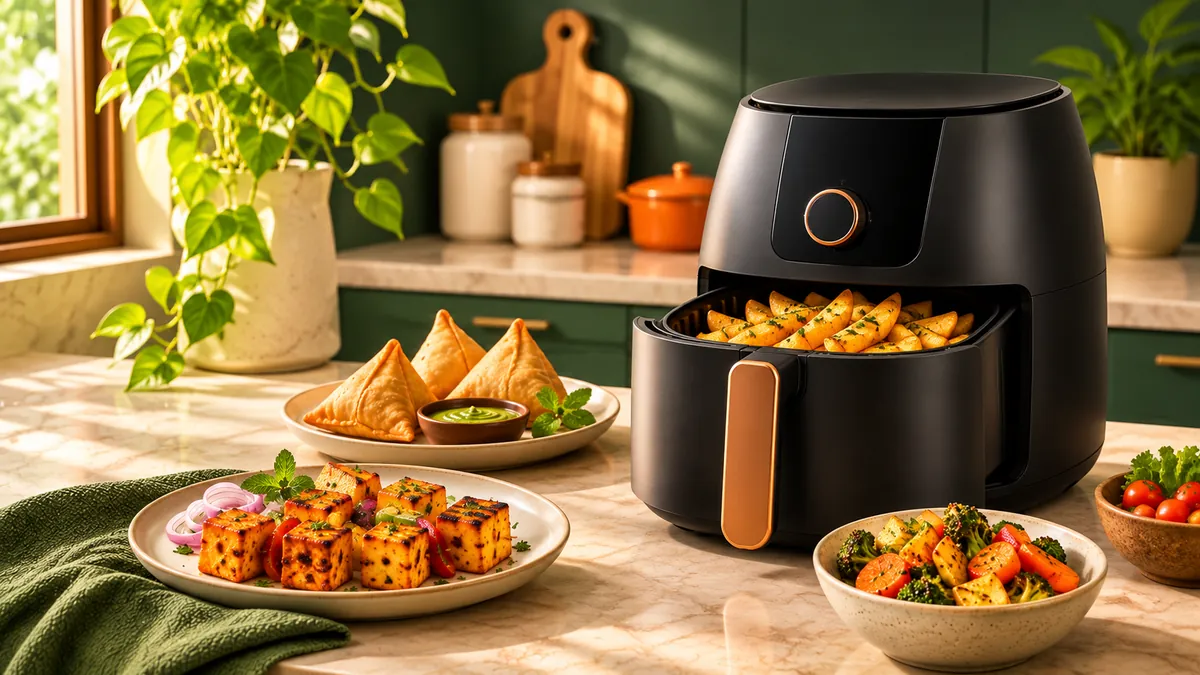
Air Fryer Electricity Consumption in India: How Many Units Does It Use?
The cost of running an air fryer depends on its power rating, actual heating time, cooking duration and your electricity tariff. The wattage printed on a label is a power rating—not a fixed number of units consumed for every meal.
How to calculate air fryer electricity units
Most electricity bills use kilowatt-hours (kWh), also called units. The straightforward rated-load estimate is:
Electricity units (kWh) = Power (watts) ÷ 1,000 × Time (hours)
For a 1,500 W model running for 20 minutes at full rated input: 1,500 ÷ 1,000 × (20 ÷ 60) = 0.5 kWh.
For cost, multiply those units by the per-unit rate you actually pay. India has different tariff structures by state, supplier, consumption slab and billing arrangement, so there is no single correct nationwide ₹/unit figure.
Example cooking cost table
These are illustrative full-rated-power calculations, not measurements from specific products. Each assumes a flat tariff of ₹8/kWh and that the appliance draws the listed wattage throughout the stated interval.
| Power rating | Cooking time | Calculated energy | Illustrative cost |
|---|---|---|---|
| 1,000 W | 15 minutes | 0.25 kWh | ₹2.00 |
| 1,500 W | 20 minutes | 0.50 kWh | ₹4.00 |
| 1,800 W | 30 minutes | 0.90 kWh | ₹7.20 |
Illustrative arithmetic only. Rated wattage, active-heater time, thermostat cycling, preheat and actual tariff can change the amount shown on your bill.
Why actual consumption can be different
1. The heater may cycle on and off
Some appliances regulate heat by cycling the heating element. When the element is off, electricity draw can differ from its full rated power. A model’s controls, heater size and target temperature affect these cycles.
2. Preheating adds time
If you include a separate preheat period, count its energy as well. Whether preheating is recommended depends on the model and recipe; consult the owner’s manual.
3. Batch size changes total time
Cooking two batches can consume more total electricity than one well-spaced batch, even if each batch uses the same temperature. But overcrowding can reduce cooking quality. The family-size air fryer guide explains capacity trade-offs.
4. Temperature and food conditions matter
Thicker foods, frozen ingredients and different cooking methods can change the duration. A wattage comparison alone cannot tell you which specific model will use less energy for your usual meals.
How to measure your real air fryer usage
- Find the rated wattage on the appliance label or the exact model’s manual.
- Record a normal cooking session, including preheat and any additional batches.
- For an approximate calculation, use the formula above with total minutes.
- For a more precise observation, use a suitably rated, reputable plug-in energy monitor that is compatible with your appliance’s electrical load and outlet. Follow its safety instructions.
- Use the effective unit rate from your own electricity bill for the cost estimate.
Does an air fryer always use less electricity than an oven?
Not necessarily. It depends on the quantity and recipe, each appliance’s draw and how long it needs to run. Small meals may be convenient in an air fryer; large batches or different cooking tasks can change the comparison. Compare kWh per completed meal, not just wattage. For general information on electricity efficiency, see the Bureau of Energy Efficiency; it does not certify the cost examples in this article.
Practical tips to avoid wasted energy
- Match appliance size to the portions you regularly cook rather than choosing the largest model by default.
- Follow a tested recipe and the manufacturer’s guidance so you do not repeatedly extend cooking time.
- Keep the basket and appliance clean according to the manual; residue can affect cooking quality.
- Allow sufficient space for air circulation, without overfilling the basket.
- Use your actual tariff rather than trusting a generic monthly-cost estimate.
Frequently asked questions
How many units does a 1,500 W air fryer use in 30 minutes?
At full 1,500 W draw for the entire 30 minutes: 1.5 kW × 0.5 hours = 0.75 kWh. Actual energy use can differ because the heater may cycle.
Can I calculate monthly electricity cost?
Yes. Estimate kWh per meal, multiply by the number of similar meals per month, and then apply the relevant tariff. For example, 0.5 kWh per use × 20 uses = 10 kWh; at an illustrative ₹8/kWh, the energy-only cost is ₹80.
Does higher wattage mean better cooking?
No. Rated wattage is only one specification. Basket geometry, heating control, capacity and the recipe also matter.
Does an air fryer draw full power continuously?
Not always. Depending on its controls and heating cycle, a model can draw less power during parts of a cooking session. A compatible energy monitor is the best way to observe actual energy for your individual appliance.
Continue with the Best Air Fryer in India guide, compare models under ₹5,000, or explore air fryers for Indian recipes.
For maintenance issues that may affect normal operation, see our air fryer troubleshooting guide.
Research note: examples are mathematically calculated scenarios, not independent power measurements of specific products. See our research methodology and affiliate disclosure.